
Kabaddi's Second Innings: From the Mud Akhara to the League Mat
कबड्डी में पिछले एक दशक का सबसे बड़ा बदलाव सतह और नियमों का है: मिट्टी के अखाड़े की जगह मैट ने ली, और सुपर टैकल व डू-ऑर-डाई रेड जैसे प्रावधानों ने मैच का टेम्पो तेज़ किया। 2014 में शुरू प्रो कबड्डी लीग ने फ्रेंचाइज़ी, नीलामी और प्रसारण के जरिए खिलाड़ियों के लिए नियमित आय का रास्ता बनाया, हालांकि यह लाभ मुख्यतः शीर्ष कुछ सौ खिलाड़ियों तक सीमित है। मुख्य चुनौतियां तीन हैं — महिला कबड्डी को समान मंच और प्रसारण न मिलना, साल भर का प्रतिस्पर्धी कैलेंडर न होना, और अनुबंध समाप्ति के बाद चोट-इलाज तथा खिलाड़ी कल्याण की निरंतरता सुनिश्चित न होना।
In rural India, kabaddi was never merely a sport; it was part of the season itself. An empty field after the harvest, a straight line drawn in lime, dust under bare feet, and between two sides that breath-holding chant of "kabaddi, kabaddi" — that scene lived in the collective memory of rural India for generations. Yet in the world of stadiums, television and contracts, the sport had no place. Over the past decade that picture has changed, and the change is not merely one of coverage but of the sport's internal architecture.
The Pro Kabaddi League, launched in 2026, worked on the same template cricket's IPL had used — franchises, auctions, broadcast, graphics and star culture. It began with eight teams and later expanded to twelve. But kabaddi's case differs from cricket's. Here money was the end product, not the originating cause. What actually changed was the sport's physical conditions, its rulebook, the language of coaching, and the economic standing of the player.
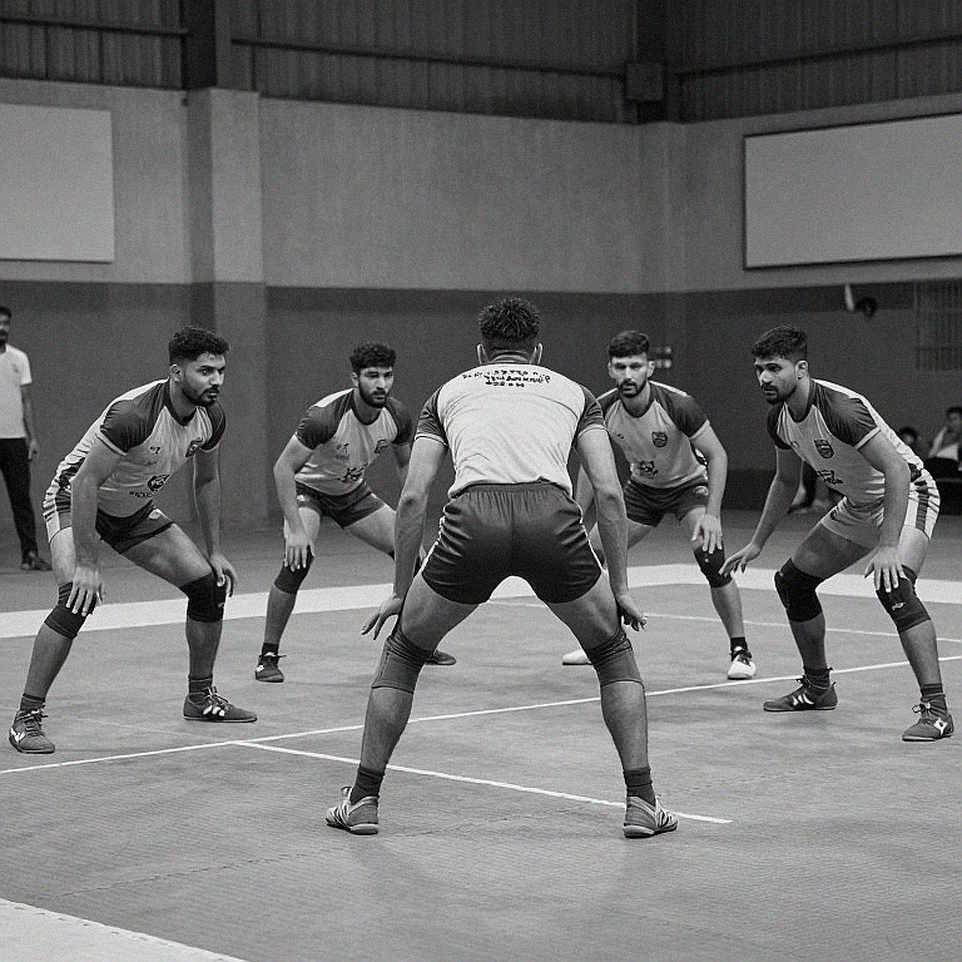
The biggest technical shift was the surface. In a mud akhara, a player's grip, the sliding, the angle of a fall and the speed of rising all follow a different mathematics. On the mat, all of it changes — feet move faster, but holding balance becomes harder, and the nature of injury changes too. Players who grew up on mud had to learn the language of the mat separately. This was not a change of surface alone; it was a rewriting of the sport's entire physical grammar.
The rules were also intervened in. Provisions such as the super tackle, bonus points for an all-out, and the do-or-die raid altered the tempo of a match. Where previously a defensive side had room to run down the clock, now every raid and every tackle put points at stake. The result is that the last five minutes of a match are far more decisive than before, and teams must stay active for the full forty minutes.
The centre of strategy shifted as well. Once a raider's job was simple — take a point and return safely, and if you cannot return, at least burn time. Now a raid is a calculation: the position of opposing defenders, distance to the court's edge, the risk of crossing the baulk line, and whether the team needs two points rather than three. The modern raider knows which defender has the weakest hold and which corner is safest to slip past.
Behind this shift lies data. Video analysis, API-driven statistics and performance tracking are now standard tools for teams. Coaches once relied on the eye; now they can tell which player's tackle success rate drops on the third attempt, or which raider performs better on the left of the court. Talent selection has changed with it. Once a player who looked good in trials was picked; now long-run numbers are examined.
The status of defence has changed too. Once defence was treated as the last resort after raiding. Now defence decides the turning point. A successful tackle does not merely yield a point; it breaks the opposing raider's confidence and forces haste in his next raid. That is why teams now invest heavily in defenders, whereas in the early auctions the highest prices went to raiders.
The change is most concrete in the player's economy. For a player arriving from a village, a regular profession became possible for the first time. Previously a kabaddi player's main income came from a sports-quota government job or from police and railway teams. Now contracts, match fees and sponsorship open other routes. The change is incomplete and limited to a few hundred top players, but it has made sport a legitimate career option for rural families.
Women's kabaddi is a different story, and one far less told. The Indian women's team has long been strong internationally, but domestically it has not received the same platform or the same broadcast time. Contract numbers for women players have remained limited and the share of media coverage far below that of the men's game. This is the sport's biggest unrealised possibility — the day women's league receives the same investment and broadcast, the sport's audience base could nearly double.
The grassroots network is the foundation of this entire structure. Morning akharas still run in villages across Haryana, Uttar Pradesh, Maharashtra, Tamil Nadu and parts of the north-east, and it is from there that league players emerge. The league institutionalised scouting — trials, regional camps, academies. But this process still rests largely on personal contacts and local coaches' networks rather than an organised system.
The biggest challenge is the calendar. A league season compresses into a few months and for the rest of the year the player has no regular competition. That makes maintaining form difficult and increases the pressure to recover quickly from injury. In countries with a strong domestic circuit, players stay match-fit all year; in India that continuity does not yet exist.
Injury management and player welfare follow directly from this. Kabaddi places heavy load on knees, ankles and shoulders, and mat injuries differ from those suffered on mud. Teams now have better physio and rehabilitation support than before, but continuity of treatment after a contract ends remains a question. Likewise there is no systematic plan for post-retirement careers.
On the international stage, kabaddi has been part of the Asian Games since 2026, and India dominated the sport for a long time. That dominance is no longer absolute — teams such as Iran have claimed parity in strategy and fitness. This is good news for the sport. One-sided contests do not build audiences; when more countries arrive with a realistic chance of winning, the sport acquires global shape.
Coordination between league and national team is a standing debate. The league calendar, the timing of national camps and the dates of international competitions often collide. The commercial league protects its owners' investment, while the national team needs preparation time. Only a shared, long-term calendar can resolve this friction.
It is also worth remembering that the league has not eliminated the akhara. Kabaddi is still played in villages without any broadcast and without any contract, and that remains the sport's real source. The day rural competitions receive organised status, fixed prize money and local broadcast, the sport's foundation will grow stronger.
Questions are also raised about the franchises' economic model. Ticketing and broadcast rights are the main revenue sources, but ticket sales in smaller cities remain limited and team costs keep rising. Long-term stability requires the league to carry its base beyond the cities and build a local spectator culture rather than depend only on television ratings.
The language of coverage has changed too. Kabaddi was once dismissed as "the poor man's game", diminishing its seriousness. Now the talk is of analysis, statistics and strategy, and that shift changes the sport's standing. When the media reads a sport seriously, audiences take it seriously as well.
The road ahead rests on three things: a permanent and dignified platform for a women's league, a year-round competitive calendar, and a systematic chain of player welfare from grassroots to the top. Kabaddi has proved over the past decade that it has both sporting thrill and cultural connection. The question is no longer whether kabaddi can become big — it is how durable that growth will be.
संबंधित खिलाड़ी
अनुशंसित
The Empty Column: Why 'Not Available' Is Kabaddi Reporting's Most Trusted Line2026-10-30
First Commonwealth Kabaddi Championship in Ahmedabad: The Arithmetic of 62 Matches, the Question of 23, and the CWG 2030 File2026-10-23
Commonwealth Kabaddi Championship 2026: What the Day-1 Scoreboard Said, and What the Mat Said2026-10-24
Three Hamstrings, Eleven Days: The PKL Calendar the Medical Bulletin Never Showed2026-10-27
Surjeet Singh captain, Naveen Kumar deputy: India's real test in Ahmedabad begins with the leadership announcement2026-10-30
Commonwealth Kabaddi Championship: India Open Against Malaysia and England as Ahmedabad Hosts 62 Matches Across 13 Nations2026-10-28
अनुशंसित
Technical Failure: This Kabaddi Report Cannot Be Produced2026-10-31
Kabaddi's Data Crisis: Why Every Raid Success Rate Needs a Sample Size2026-10-23
Surjeet Singh Captain, Naveen Kumar Deputy — Captaincy Is Not the Biggest Question at the Commonwealth Kabaddi Championship2026-10-23
Surjeet Singh captain, Naveen Kumar deputy: India's real test in Ahmedabad begins with the leadership announcement2026-10-30
The Auction Hammer and the Railway Slip: The Real Ledger of Kabaddi's Transfer Window2026-10-23
Commonwealth Kabaddi Championship 2026: 13 Nations, Nine Days in Ahmedabad, and a Question Nobody Has Answered2026-10-23